 Add to Chrome
 Add to Firefox
 Add to Edge
Paris 2.0: A Decentralized Diffusion Model for Video Generation
May 28, 2026
We present Paris 2.0, the first video generation model pre-trained through decentralized computation. Its training recipe builds upon Paris 1.0 (arXiv:2510.03434), the first ever open-weight Decentralized Diffusion Model (DDM), which showed that image generation can be trained without a monolithic GPU cluster. However, temporally coherent video generation had remained an open problem under decentralized training, and Paris 2.0 closes it. In low-resolution text-to-video training, against a monolithic model trained on the same data under a matched total compute budget, Paris 2.0 cuts Frechet Video Distance (FVD) from 561.04 to 279.01, a ~2.0x improvement, and lifts CLIP text-video similarity and aesthetic score.

DRFusion: Drift-Resilient Temporally Consistent Infrared-Visible Video Fusion
May 25, 2026Infrared and visible video fusion is essential for achieving comprehensive perception in dynamic scenes. However, maintaining temporal consistency remains a formidable challenge. Conventional methods relying on optical flow often suffer from geometric rigidity and ghosting artifacts. Moreover, standard diffusion-based fusion models typically operate in a frame-by-frame manner; when extended to autoregressive settings, they lack intrinsic temporal constraints and are prone to severe error accumulation and drifting, where minor artifacts amplify over time. To address these limitations, we propose a drift-resilient video fusion method that reformulates the task as history-conditioned motion generation. We introduce Stabilized History Guidance and Soft Temporal Anchoring to reframe temporal consistency as spectral filtering, implicitly aggregating motion dynamics without rigid alignment. Furthermore, our Decoupled Structure-Motion Adaptation strategy bridges pre-trained priors and structural constraints via two-stage training and latent refinement. Extensive experiments demonstrate that our method achieves state-of-the-art performance in both fusion quality and temporal stability.
Uncertainty-aware Spatial-Frequency Registration and Fusion for Infrared and Visible Images
May 13, 2026Infrared and Visible Image Fusion (IVIF) has shown promise in visual tasks under challenging environments, but fusion under unregistered conditions faces inherent misalignments. Current studies to solve them either predict the deformation parameters coarse-to-fine (i.e., coarse registration and fine registration) or estimate the deformation fields in multi-scales for registration. Though straightforward, they overlook the cumulative errors in registration, which contaminate the fusion stage and severely deteriorate the resulting images. We introduce the Spatial-Frequency Registration and Fusion (SFRF) framework, which incorporates uncertainty estimation and infrared thermal radiation distribution consistency into a unified pipeline to handle the error accumulation for robust registration and fusion across both spatial and frequency domains. Specifically, SFRF constructs a Multi-scale Iterative Registration (MIR) framework that iteratively refines the deformation field across scales, leveraging uncertainty estimation at each stage to mitigate error accumulation and enhance alignment accuracy dynamically. To ensure the accurate alignment of infrared thermal distributions during registration, thermal radiation distribution consistency is employed as a frequency-domain supervisory signal, promoting global consistency in the frequency domain. Based on the spatial-frequency alignment, SFRF further adopts a Dual-branch Spatial-Frequency Fusion (DSFF) module, which incorporates spatial geometric features and frequency distribution information to reconstruct visually appealing images. SFRF achieves impressive performance across diverse datasets.
UniFusion: A Unified Image Fusion Framework with Robust Representation and Source-Aware Preservation
Mar 15, 2026Image fusion aims to integrate complementary information from multiple source images to produce a more informative and visually consistent representation, benefiting both human perception and downstream vision tasks. Despite recent progress, most existing fusion methods are designed for specific tasks (i.e., multi-modal, multi-exposure, or multi-focus fusion) and struggle to effectively preserve source information during the fusion process. This limitation primarily arises from task-specific architectures and the degradation of source information caused by deep-layer propagation. To overcome these issues, we propose UniFusion, a unified image fusion framework designed to achieve cross-task generalization. First, leveraging DINOv3 for modality-consistent feature extraction, UniFusion establishes a shared semantic space for diverse inputs. Second, to preserve the understanding of each source image, we introduce a reconstruction-alignment loss to maintain consistency between fused outputs and inputs. Finally, we employ a bilevel optimization strategy to decouple and jointly optimize reconstruction and fusion objectives, effectively balancing their coupling relationship and ensuring smooth convergence. Extensive experiments across multiple fusion tasks demonstrate UniFusion's superior visual quality, generalization ability, and adaptability to real-world scenarios. Code is available at https://github.com/dusongcheng/UniFusion.
Toward Real-world Infrared Image Super-Resolution: A Unified Autoregressive Framework and Benchmark Dataset
Mar 05, 2026Infrared image super-resolution (IISR) under real-world conditions is a practically significant yet rarely addressed task. Pioneering works are often trained and evaluated on simulated datasets or neglect the intrinsic differences between infrared and visible imaging. In practice, however, real infrared images are affected by coupled optical and sensing degradations that jointly deteriorate both structural sharpness and thermal fidelity. To address these challenges, we propose Real-IISR, a unified autoregressive framework for real-world IISR that progressively reconstructs fine-grained thermal structures and clear backgrounds in a scale-by-scale manner via thermal-structural guided visual autoregression. Specifically, a Thermal-Structural Guidance module encodes thermal priors to mitigate the mismatch between thermal radiation and structural edges. Since non-uniform degradations typically induce quantization bias, Real-IISR adopts a Condition-Adaptive Codebook that dynamically modulates discrete representations based on degradation-aware thermal priors. Also, a Thermal Order Consistency Loss enforces a monotonic relation between temperature and pixel intensity, ensuring relative brightness order rather than absolute values to maintain physical consistency under spatial misalignment and thermal drift. We build FLIR-IISR, a real-world IISR dataset with paired LR-HR infrared images acquired via automated focus variation and motion-induced blur. Extensive experiments demonstrate the promising performance of Real-IISR, providing a unified foundation for real-world IISR and benchmarking. The dataset and code are available at: https://github.com/JZD151/Real-IISR.
Bridging Human Evaluation to Infrared and Visible Image Fusion
Mar 04, 2026Infrared and visible image fusion (IVIF) integrates complementary modalities to enhance scene perception. Current methods predominantly focus on optimizing handcrafted losses and objective metrics, often resulting in fusion outcomes that do not align with human visual preferences. This challenge is further exacerbated by the ill-posed nature of IVIF, which severely limits its effectiveness in human perceptual environments such as security surveillance and driver assistance systems. To address these limitations, we propose a feedback reinforcement framework that bridges human evaluation to infrared and visible image fusion. To address the lack of human-centric evaluation metrics and data, we introduce the first large-scale human feedback dataset for IVIF, containing multidimensional subjective scores and artifact annotations, and enriched by a fine-tuned large language model with expert review. Based on this dataset, we design a domain-specific reward function and train a reward model to quantify perceptual quality. Guided by this reward, we fine-tune the fusion network through Group Relative Policy Optimization, achieving state-of-the-art performance that better aligns fused images with human aesthetics. Code is available at https://github.com/ALKA-Wind/EVAFusion.
Expert-Data Alignment Governs Generation Quality in Decentralized Diffusion Models
Feb 02, 2026Decentralized Diffusion Models (DDMs) route denoising through experts trained independently on disjoint data clusters, which can strongly disagree in their predictions. What governs the quality of generations in such systems? We present the first ever systematic investigation of this question. A priori, the expectation is that minimizing denoising trajectory sensitivity -- minimizing how perturbations amplify during sampling -- should govern generation quality. We demonstrate this hypothesis is incorrect: a stability-quality dissociation. Full ensemble routing, which combines all expert predictions at each step, achieves the most stable sampling dynamics and best numerical convergence while producing the worst generation quality (FID 47.9 vs. 22.6 for sparse Top-2 routing). Instead, we identify expert-data alignment as the governing principle: generation quality depends on routing inputs to experts whose training distribution covers the current denoising state. Across two distinct DDM systems, we validate expert-data alignment using (i) data-cluster distance analysis, confirming sparse routing selects experts with data clusters closest to the current denoising state, and (ii) per-expert analysis, showing selected experts produce more accurate predictions than non-selected ones, and (iii) expert disagreement analysis, showing quality degrades when experts disagree. For DDM deployment, our findings establish that routing should prioritize expert-data alignment over numerical stability metrics.
HATIR: Heat-Aware Diffusion for Turbulent Infrared Video Super-Resolution
Jan 08, 2026Infrared video has been of great interest in visual tasks under challenging environments, but often suffers from severe atmospheric turbulence and compression degradation. Existing video super-resolution (VSR) methods either neglect the inherent modality gap between infrared and visible images or fail to restore turbulence-induced distortions. Directly cascading turbulence mitigation (TM) algorithms with VSR methods leads to error propagation and accumulation due to the decoupled modeling of degradation between turbulence and resolution. We introduce HATIR, a Heat-Aware Diffusion for Turbulent InfraRed Video Super-Resolution, which injects heat-aware deformation priors into the diffusion sampling path to jointly model the inverse process of turbulent degradation and structural detail loss. Specifically, HATIR constructs a Phasor-Guided Flow Estimator, rooted in the physical principle that thermally active regions exhibit consistent phasor responses over time, enabling reliable turbulence-aware flow to guide the reverse diffusion process. To ensure the fidelity of structural recovery under nonuniform distortions, a Turbulence-Aware Decoder is proposed to selectively suppress unstable temporal cues and enhance edge-aware feature aggregation via turbulence gating and structure-aware attention. We built FLIR-IVSR, the first dataset for turbulent infrared VSR, comprising paired LR-HR sequences from a FLIR T1050sc camera (1024 X 768) spanning 640 diverse scenes with varying camera and object motion conditions. This encourages future research in infrared VSR. Project page: https://github.com/JZ0606/HATIR
DifIISR: A Diffusion Model with Gradient Guidance for Infrared Image Super-Resolution
Mar 03, 2025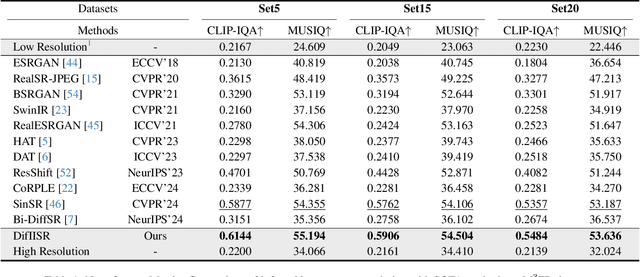
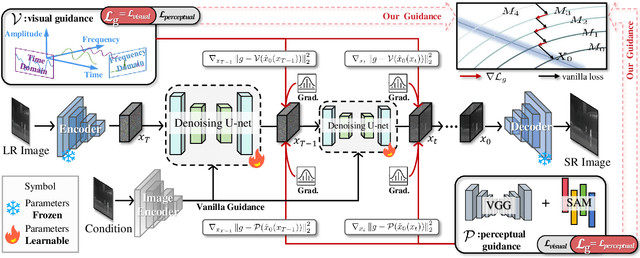

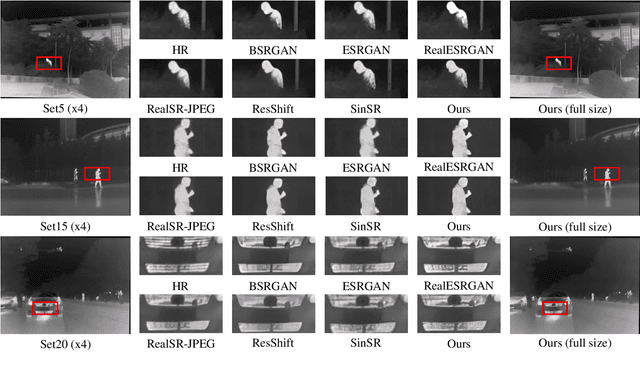
Infrared imaging is essential for autonomous driving and robotic operations as a supportive modality due to its reliable performance in challenging environments. Despite its popularity, the limitations of infrared cameras, such as low spatial resolution and complex degradations, consistently challenge imaging quality and subsequent visual tasks. Hence, infrared image super-resolution (IISR) has been developed to address this challenge. While recent developments in diffusion models have greatly advanced this field, current methods to solve it either ignore the unique modal characteristics of infrared imaging or overlook the machine perception requirements. To bridge these gaps, we propose DifIISR, an infrared image super-resolution diffusion model optimized for visual quality and perceptual performance. Our approach achieves task-based guidance for diffusion by injecting gradients derived from visual and perceptual priors into the noise during the reverse process. Specifically, we introduce an infrared thermal spectrum distribution regulation to preserve visual fidelity, ensuring that the reconstructed infrared images closely align with high-resolution images by matching their frequency components. Subsequently, we incorporate various visual foundational models as the perceptual guidance for downstream visual tasks, infusing generalizable perceptual features beneficial for detection and segmentation. As a result, our approach gains superior visual results while attaining State-Of-The-Art downstream task performance. Code is available at https://github.com/zirui0625/DifIISR
Infrared and Visible Image Fusion: From Data Compatibility to Task Adaption
Jan 18, 2025Infrared-visible image fusion (IVIF) is a critical task in computer vision, aimed at integrating the unique features of both infrared and visible spectra into a unified representation. Since 2018, the field has entered the deep learning era, with an increasing variety of approaches introducing a range of networks and loss functions to enhance visual performance. However, challenges such as data compatibility, perception accuracy, and efficiency remain. Unfortunately, there is a lack of recent comprehensive surveys that address this rapidly expanding domain. This paper fills that gap by providing a thorough survey covering a broad range of topics. We introduce a multi-dimensional framework to elucidate common learning-based IVIF methods, from visual enhancement strategies to data compatibility and task adaptability. We also present a detailed analysis of these approaches, accompanied by a lookup table clarifying their core ideas. Furthermore, we summarize performance comparisons, both quantitatively and qualitatively, focusing on registration, fusion, and subsequent high-level tasks. Beyond technical analysis, we discuss potential future directions and open issues in this area. For further details, visit our GitHub repository: https://github.com/RollingPlain/IVIF_ZOO.